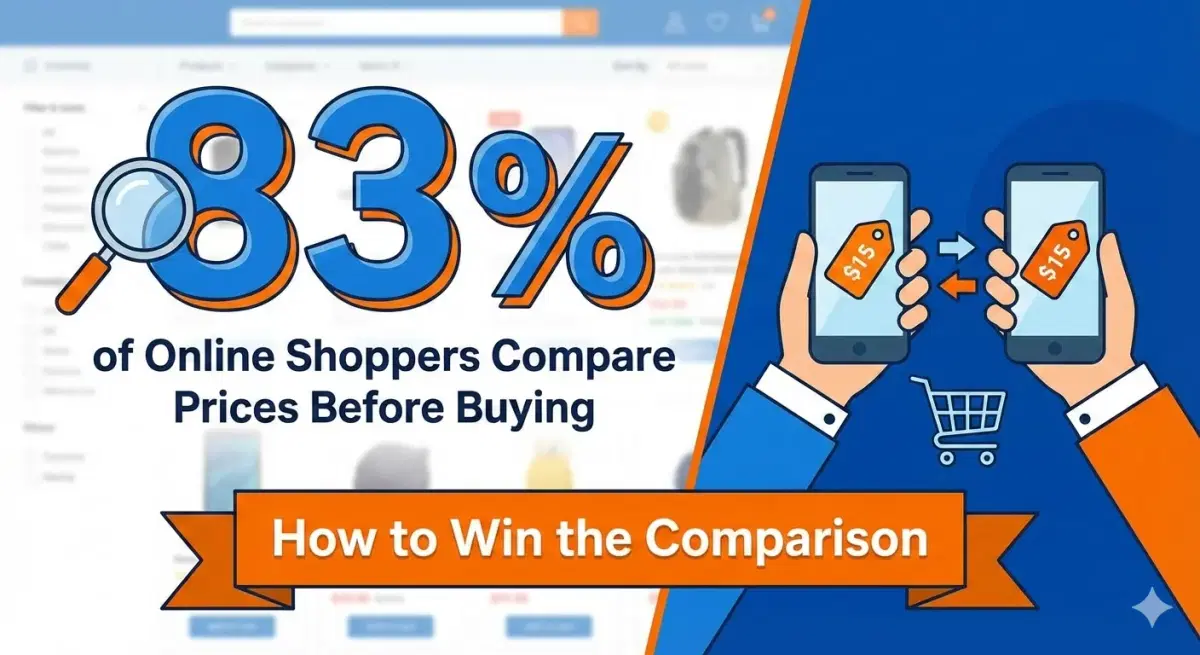
83% of Online Shoppers Compare Prices Before Buying: How to Win the Comparison
John Choi
E-commerce StrategyFounder of Rivalert
Before your customer clicks "Add to Cart," they've probably already checked three other websites. According to Shopify's 2024 Holiday Retail Report, which surveyed 18,000 consumers across nine countries, 83% of shoppers compare prices to find the best deals before making a purchase.
This isn't just window shopping—it's the new normal for online buying behavior. And if you're not thinking about how your prices stack up against competitors, you're likely losing sales without even knowing it.
The Reality of Price Comparison Shopping
Let's break down what's actually happening when someone visits your store:
- They find a product they like
- They open a new tab
- They search for the same product on Amazon, Google Shopping, or competitor sites
- They compare prices, shipping costs, and reviews
- They buy from whoever offers the best overall value
This entire process takes less than a minute. And 83% of your potential customers are doing it.
Price Comparison Is Intensifying
Price comparison behavior has intensified in recent years. According to 1WorldSync's 2024 Product Content Benchmark report, the percentage of shoppers searching 4+ sites before making significant purchases increased from 20% in 2023 to 26% in 2024.
Why Customers Compare Prices (It's Not Just About Being Cheap)
Understanding why customers compare prices helps you compete more effectively. Here's what research tells us:
1. Trust Verification
Customers aren't just looking for the lowest price—they're verifying that your price is fair. Seeing consistent pricing across multiple sites builds confidence. Seeing a significantly higher price than competitors triggers suspicion.
2. Fear of Missing Out
Nobody wants to overpay. The emotional cost of discovering a better deal after purchase often outweighs the time spent researching. Price comparison is risk mitigation.
3. Easy Access to Information
Unlike shopping in physical stores, comparing online prices requires almost zero effort. A quick search reveals dozens of options instantly.
4. Economic Pressure
With inflation and economic uncertainty, shoppers are more price-conscious than ever. As of 2024, 65% of shoppers have purchased from budget sites like Temu and Shein—up 11 percentage points from 2023.
The Hidden Cost of Losing Price Comparisons
When customers compare your prices to competitors and choose to buy elsewhere, you lose more than one sale:
The last point is critical. When customers silently leave for competitors, you have no feedback loop. You might think you have a traffic problem when you actually have a pricing problem.
Automate Your Competitor Monitoring
Stop manually checking competitor prices. Rivalert tracks changes and sends you alerts automatically.
How Top E-commerce Stores Win Price Comparisons
Winning the price comparison isn't always about having the lowest price. Here's how successful online stores approach it:
Strategy 1: Know Your Price Position
Before you can compete, you need to know where you stand. Are your prices:
- Below market - Good for conversions, but are you leaving money on the table?
- At market - Competitive, but you need other differentiators
- Above market - Only sustainable with strong brand or unique value
Most stores guess their price position. The smart ones monitor it continuously.
Strategy 2: Compete on Total Value, Not Just Price
The "price" customers compare includes:
- Product price
- Shipping costs
- Delivery time
- Return policy
- Trust signals (reviews, established brand)
- Product quality indicators
If you can't beat competitor prices, can you offer free shipping? Faster delivery? A better return policy? These factors matter in the comparison.
Strategy 3: Match Strategically, Not Universally
You don't need to be the cheapest on every product. Focus on:
- Loss leaders - Price key products competitively to get customers in the door
- Bestsellers - Stay competitive on products that drive most of your traffic
- Comparison items - Products commonly cross-shopped with competitors
Strategy 4: Time Your Pricing Right
Competitor prices aren't static. They change based on:
- Inventory levels
- Promotional calendars
- Seasonal demand
- Competitive pressure
When a competitor raises prices, that's an opportunity. When they drop prices, you need to know immediately.
The 24-Hour Window
According to Google Ads conversion path data, nearly 60% of ecommerce conversions occur within 1 day of the initial interaction. If you don't know about a competitor price change for a week, you've potentially lost 7 days of customers who compared prices and went elsewhere.
The Price Comparison Journey: Where You Win or Lose
Understanding the customer's comparison journey reveals your best intervention points:
Stage 1: Discovery
Customer finds your product through search, ads, or social media. At this stage, they don't know your competitors' prices yet.
Your opportunity: First impression matters. Clear pricing, professional presentation, and visible trust signals reduce the urge to comparison shop.
Stage 2: Research
Customer opens new tabs, searches for alternatives, checks Amazon. This is where you win or lose most sales.
Your opportunity: If you're priced competitively, you win. If not, your value proposition needs to be compelling enough to justify the difference.
Stage 3: Evaluation
Customer weighs options: price vs. shipping vs. reviews vs. trust. Often happens in 60 seconds or less.
Your opportunity: Total value matters. Free shipping, great reviews, and a trustworthy appearance can offset higher prices.
Stage 4: Decision
Customer makes final choice and completes purchase—or bounces to a competitor.
Your opportunity: Clear checkout, multiple payment options, and no surprise fees keep customers from second-guessing at the last moment.
Practical Steps to Compete in a Price-Comparison World
Here's an actionable plan for any Shopify store owner:
Week 1: Baseline Your Competition
- List your top 5-10 competitors (stores your customers also shop at)
- Identify your 20 bestselling products
- Manually check competitor prices for these products
- Document where you're higher, lower, or matched
Week 2: Analyze Patterns
- Which products are you consistently overpriced on?
- Where are you leaving money on the table with low prices?
- How often do competitor prices change?
- What's your average price difference?
Week 3: Develop Strategy
- Decide your price position for each product category
- Identify which products need price adjustments
- Create a monitoring schedule (or automate it)
- Set thresholds for when to adjust prices
Week 4: Implement and Monitor
- Make strategic price adjustments
- Set up automated competitor monitoring
- Track conversion rate changes
- Refine based on results
Automate Your Monitoring
Rivalert automatically tracks your competitors' Shopify stores and alerts you when they change prices, add new products, or run promotions. Know what your competitors are doing before your customers do.
The Mobile Factor: Comparison Shopping Goes Everywhere
Price comparison isn't just happening on desktops. According to 1WorldSync's 2024 report, smartphone use for in-store product research doubled from 2023 to 2024, with 11% of shoppers pulling out their phones during every shopping trip.
This means:
- Customers compare your prices even while standing in physical stores
- Mobile-friendly competitor research takes seconds
- Price transparency is essentially universal
Beyond Price: When Comparison Shopping Works in Your Favor
Here's the good news: not every comparison ends with the lowest price winning. Customers also compare:
- Product reviews and ratings
- Shipping speed and cost
- Return policies
- Brand reputation
- Website trustworthiness
- Product descriptions and photos
- Customer service reputation
If your store excels in these areas, you can often win even at slightly higher prices. But you need to know what you're competing against.
The Bottom Line: You Can't Win What You Don't Monitor
The 83% statistic isn't going away. If anything, price comparison behavior is intensifying as tools make it easier and economic pressures make customers more price-conscious.
The stores that thrive understand that:
- Most customers compare prices - This is a given, not an exception
- Price position is dynamic - It changes daily as competitors adjust
- Visibility is essential - You can't compete effectively if you don't know competitor prices
- Speed matters - The faster you know about price changes, the faster you can respond
Whether you're the premium option or the budget choice, knowing how your prices compare to competitors isn't optional anymore—it's essential for survival.
References
- Shoppers more intentional: 83% compare prices while 65% plan to shop during sales to save money, Shopify finds - Retail Times
- 73% of Consumers are Moving Their Shopping More Online in 2024 - 1WorldSync
- Showrooming vs. Webrooming: New trends in customer engagement - The Business & Financial Times
- 70+ Online Shopping Statistics - 2025 Report - inBeat Agency
- Conversion Time Lag Explained: How Buyers Actually Convert - Five Nine Strategy
Try Rivalert Free
Shopify Competitor Price Monitoring. Start your 7-day free trial today.
Start Free TrialRelated Articles
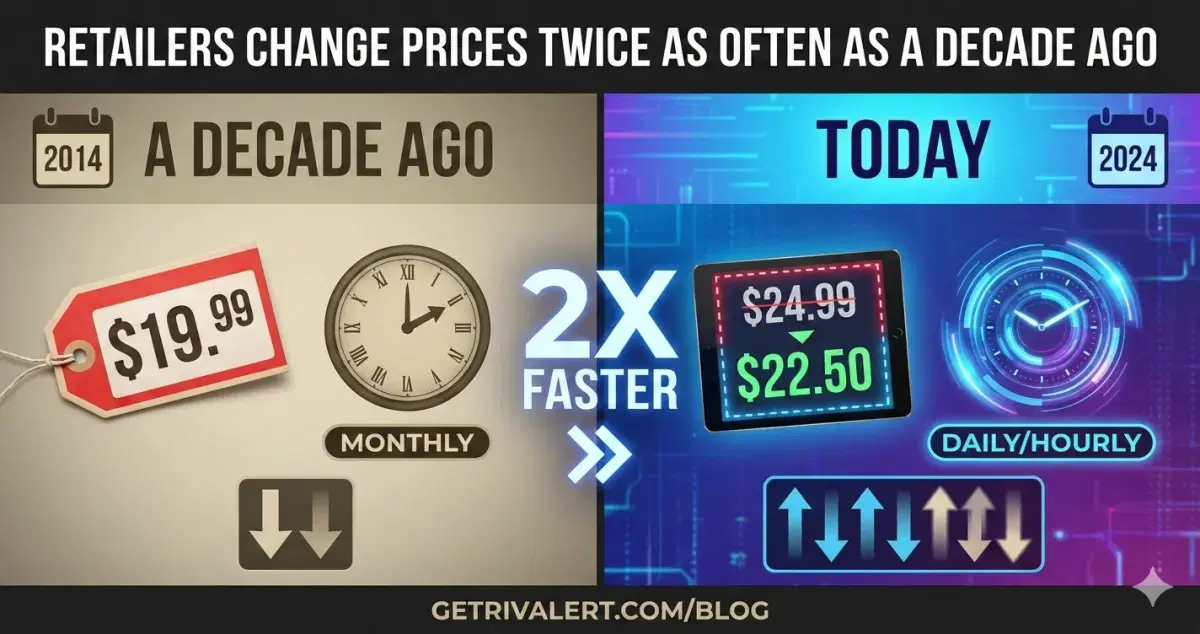
Retailers Now Change Prices Twice as Often as a Decade Ago: Why Competitor Price Tracking Matters More Than Ever
![Dropshipping Market Reaches $435 Billion with 22% Annual Growth [2026 Analysis]](/_next/image?url=%2Fimages%2Fblog%2Fdropshipping-market-growth.webp&w=1200&q=75)
Dropshipping Market Reaches $435 Billion with 22% Annual Growth [2026 Analysis]