53% of Unauthorized Retailers Violate MAP Pricing: What Brands Need to Know
John Choi
E-commerce StrategyFounder of Rivalert
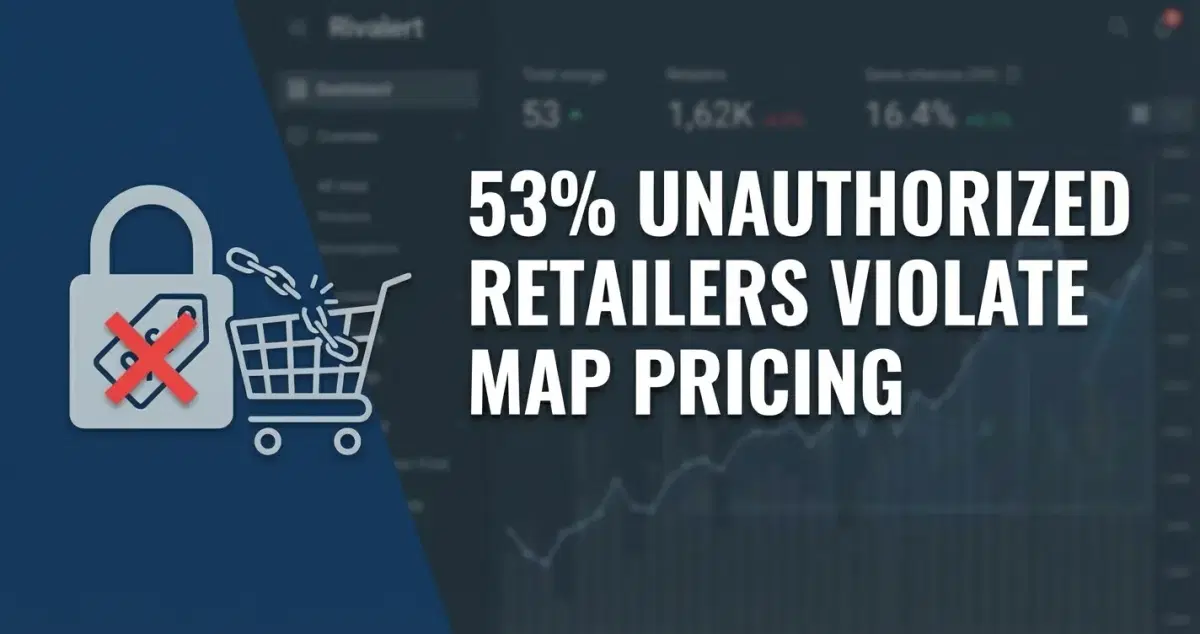
If you sell products through retail partners, here's a statistic that should concern you: 53% of unauthorized retailers violate Minimum Advertised Price (MAP) policies, according to peer-reviewed research published in Marketing Science.
That's more than half of all unauthorized sellers actively undercutting your pricing strategy. And while authorized retailers are more compliant at just 15% violation rates, the damage from unauthorized sellers often cascades through your entire distribution network.
MAP Violation Rates by Retailer Type
Source: Marketing Science (2016)
The Research Behind the Numbers
The landmark study by professors Ayelet Israeli (Harvard Business School), Eric T. Anderson, and Anne T. Coughlan (Kellogg School of Management) analyzed 226 unique products sold through over 900 authorized and unauthorized retailers.
Their findings reveal a troubling pattern for brands:
The researchers also discovered something even more concerning: 20% of retailers in the dataset always complied with MAP, while nearly 40% never did. There's very little middle ground—retailers either respect your pricing or they don't.
The Compliance Gap
The 38-percentage-point difference between unauthorized (53%) and authorized (15%) retailers represents a massive threat to brand value and channel relationships. Unauthorized sellers are more than 3x more likely to violate your MAP policy.
Why Unauthorized Retailers Violate MAP More Often
The difference in compliance rates comes down to one word: consequences.
For Authorized Retailers
When an authorized retailer violates MAP, brands have leverage:
- Supply cutoff - Manufacturers can stop shipping products
- Promotional exclusion - Violators lose access to marketing support
- Partner status - Risk losing authorized dealer designation
- Relationship damage - Long-term business implications
As the researchers note, "authorized retailers are less likely to violate MAP policies because they have the most to gain by complying with manufacturers' pricing."
For Unauthorized Retailers
Unauthorized sellers face almost no direct consequences:
- No contractual obligation - They never agreed to your MAP policy
- Difficult to identify - Often hide behind multiple storefronts
- Hard to cut off - They're getting products through gray market channels
- No relationship to lose - Nothing invested in your brand partnership
This asymmetry creates a systematic problem: the sellers most likely to violate MAP are the ones you have the least control over.
The Cascade Effect: How Unauthorized Violations Spread
Here's where it gets worse. When unauthorized retailers consistently undercut MAP:
- Authorized retailers notice - Your partners see competitors selling below MAP
- Pressure to compete - Even compliant partners feel forced to match prices
- Margin erosion - Everyone's profits suffer
- Channel conflict - Authorized retailers question the value of compliance
- Brand devaluation - Customers perceive products as worth less
The study found that while authorized and unauthorized channels largely operate separately, violations in one channel still create competitive pressure on the other.
Automate Your Competitor Monitoring
Stop manually checking competitor prices. Rivalert tracks changes and sends you alerts automatically.
Why Manual MAP Monitoring Fails
Consider the scale of modern e-commerce:
- A typical brand might have hundreds of products
- Sold across dozens of authorized retailers
- Plus unknown numbers of unauthorized sellers
- Across multiple marketplaces (Amazon, eBay, Walmart, etc.)
- With prices changing multiple times per day
Manually checking all these touchpoints is impossible. By the time you discover a violation through manual review, the damage is already done—and the violator has likely changed tactics.
What Makes Unauthorized Sellers So Hard to Control
The research highlights several reasons why unauthorized sellers are particularly problematic:
1. Product Sourcing Mystery
Unauthorized sellers obtain products through:
- Retail arbitrage (buying from your authorized retailers)
- Distributor leaks
- International gray market imports
- Wholesale diversions
- Closeout purchases
Tracing how they got your products is often impossible.
2. Marketplace Proliferation
The same unauthorized seller might operate:
- Multiple Amazon storefronts
- eBay accounts
- Their own website
- Walmart Marketplace listings
- Facebook Marketplace presence
Each requires separate monitoring and enforcement.
3. Rapid Adaptation
When you take action against one storefront, unauthorized sellers simply:
- Create new accounts
- Change business names
- Shift to different marketplaces
- Modify listing titles to avoid detection
Focus on Pattern Recognition
Rather than playing whack-a-mole with individual sellers, successful brands focus on identifying patterns—common product sourcing, similar pricing behaviors, or linked accounts—that reveal larger unauthorized selling operations.
The Hidden Costs of MAP Violations
Beyond the obvious price erosion, MAP violations cost brands in less visible ways:
Channel Partner Attrition
When authorized retailers can't compete with unauthorized sellers violating MAP, they may:
- Reduce inventory investments
- Stop promoting your products
- Drop your brand entirely
- Switch to competitors with better MAP enforcement
Customer Experience Degradation
Unauthorized sellers often:
- Ship products in poor packaging
- Provide no customer support
- Sell outdated or gray market inventory
- Damage your brand reputation through negative reviews
Lost Premium Positioning
If your products consistently appear at below-MAP prices, customers begin to perceive them as:
- Commodity products rather than premium offerings
- Less valuable than their "real" price suggests
- Appropriate for discount shopping only
Effective MAP Enforcement Strategies
Based on the research, here's what works:
1. Clear Policy Documentation
Only 41% of nearly 500 MAP policies examined clearly articulated consequences for violations. Brands with vague policies see more violations than those with specific, well-documented enforcement procedures.
2. Consistent Monitoring
The same HBR research found that brands reduced violations by 40-80% within months simply by:
- Implementing automated monitoring
- Sending notification emails to violators
- Following through on stated consequences
3. Address Unauthorized Channels
Since unauthorized retailers violate at 3.5x the rate of authorized ones, enforcement efforts should prioritize:
- Identifying unauthorized sellers
- Tracing product sourcing
- Working with marketplaces to remove unauthorized listings
- Pursuing legal action when warranted
4. Authorized Partner Support
Make compliance attractive for authorized retailers:
- Provide marketing support to compliant partners
- Offer promotional inventory access
- Recognize top-performing compliant retailers
- Create clear benefits for MAP adherence
Taking Action: A Practical Framework
If you're dealing with MAP violations, here's a starting point:
Week 1: Assessment
- Audit your current MAP policy language
- List known unauthorized sellers
- Identify your highest-violation products
- Document current violation rates
Week 2: Infrastructure
- Implement monitoring for key products and channels
- Create a violation response workflow
- Draft notification templates
- Set up tracking for violation trends
Week 3: Enforcement
- Begin sending violation notifications
- Track response rates and compliance changes
- Escalate repeat offenders
- Document all enforcement actions
Week 4: Optimization
- Analyze which enforcement tactics work
- Adjust policy language based on loopholes discovered
- Expand monitoring to additional products/channels
- Review authorized retailer support programs
Monitor Your Competitors' Retailers
Understanding how your competitors handle MAP compliance can inform your own strategy. Rivalert helps you monitor competitor Shopify stores to see how they price products and which retailers carry their brands.
The Bottom Line
The 53% violation rate among unauthorized retailers isn't just a number—it's a threat to your brand's value, your channel relationships, and your profit margins.
The good news: research shows that consistent enforcement dramatically reduces violations. Brands that monitor systematically, communicate clearly, and follow through on consequences see 40-80% reductions in violation rates.
The question isn't whether you have MAP violators. With 40% of retailers never complying and 53% of unauthorized sellers violating policies, you almost certainly do. The question is whether you have the visibility and systems to address them.
References
- Minimum Advertised Pricing: Patterns of Violation in Competitive Retail Markets - Marketing Science - Israeli, Anderson, & Coughlan (2016)
- When Retail Prices Cross the Line - Kellogg Insight - Summary of the Marketing Science research
- Pricing Policies That Protect Your Brand - Harvard Business Review - Israeli & Zelek (2020)
- Minimum Advertised Pricing (MAP) Policy Enforcement - Vorys
- MAP Compliance: Essential Strategies for Every Brand - MetricsCart
Try Rivalert Free
Shopify Competitor Price Monitoring. Start your 7-day free trial today.
Start Free TrialRelated Articles
Only 41% of MAP Policies Clearly Define Consequences: Why Your Policy Might Be Failing

How a 1% Beauty Price Increase Generates 11% Profit Growth