Retailers Now Change Prices Twice as Often as a Decade Ago: Why Competitor Price Tracking Matters More Than Ever
John Choi
E-commerce StrategyFounder of Rivalert
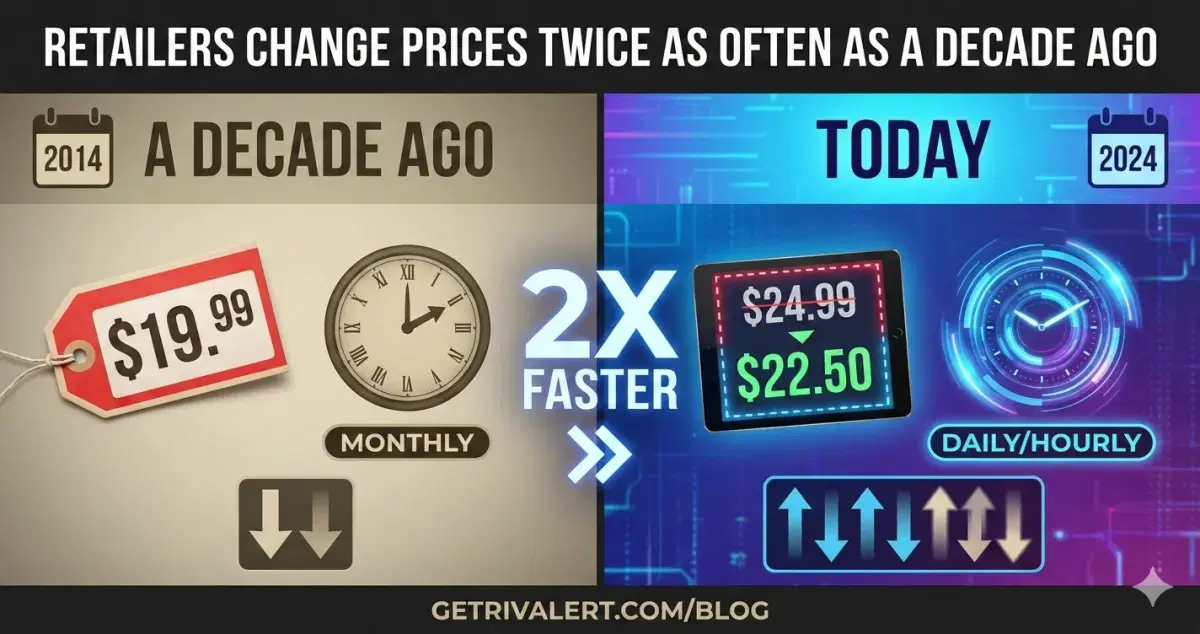
If you're still checking competitor prices once a month, you're operating on a schedule from 2010. According to Harvard Business School research by Alberto Cavallo, the frequency of price changes at multi-channel retailers has doubled—from 15% per month in 2008-2010 to nearly 30% per month by 2014-2017.
This isn't slowing down. It's accelerating. And if you're not tracking competitor pricing in real-time, you're already behind.
The Amazon Effect on Pricing Behavior
Professor Alberto Cavallo's research, published as NBER Working Paper 25138 titled "More Amazon Effects: Online Competition and Pricing Behaviors," reveals a fundamental shift in how retailers approach pricing.
The key finding: as online retailers like Amazon increased their price change frequency using dynamic pricing algorithms, traditional retailers followed suit. This created a cascading effect across all retail sectors.
Why Price Changes Accelerated
Amazon is estimated to change prices approximately 2.5 million times daily. This constant adjustment forces competitors to respond faster or risk losing sales to more agile competitors who track and react to market changes.
What "Twice as Often" Actually Means for Your Store
Let's put this statistic in practical terms:
What used to be a quarterly pricing review now needs to happen weekly—or even daily for competitive products.
The Sector-by-Sector Breakdown
Cavallo's research found the acceleration wasn't uniform across all categories:
- Electronics: Highest increase in price change frequency (intense online competition)
- Household goods: Significant increase, especially for Amazon-comparable products
- Food and beverages: More modest increase, but accelerating since Amazon entered grocery
The pattern is clear: wherever Amazon competes aggressively, price changes become more frequent. And Amazon is expanding into nearly every retail category.
Why This Matters for Competitor Price Tracking
When prices change twice as often, the implications for competitor monitoring are significant:
1. Manual Tracking Is Now Obsolete
Checking competitor prices manually once a week means you're potentially missing 50+ price changes per competitor. By the time you discover a competitor's price drop, you may have already lost a week of customers.
2. The Window for Response Has Shrunk
In 2010, you might have had months to notice and respond to a competitor's price change. Today, that window is often measured in days or hours. Customers compare prices before every purchase—and they're comparing current prices, not last week's.
3. Pricing Intelligence Is Now a Competitive Advantage
Cavallo's research shows that retailers with better visibility into competitor pricing are more likely to adopt optimal pricing strategies. Those without visibility are essentially pricing blind in a market that changes daily.
Automate Your Competitor Monitoring
Stop manually checking competitor prices. Rivalert tracks changes and sends you alerts automatically.
The Data Behind the Trend
The NBER research draws on several key data sources:
- The Billion Prices Project - Daily online price collection from hundreds of retailers
- Multi-channel retailer data - Pricing from stores that sell both online and in physical locations
- Amazon pricing data - Comparison with the market's most dynamic pricer
The findings are conclusive: online competition fundamentally changed how all retailers—not just e-commerce stores—think about and adjust prices.
Uniform Pricing Pressure
The research also found that Walmart products easily found on Amazon are more likely to have uniform pricing across locations. Online competition is eliminating regional pricing variations, meaning your competitors are likely matching the same national or global prices your customers see everywhere.
How Top Retailers Adapted
The retailers who thrived in this new environment share common characteristics:
They Invested in Price Intelligence
Successful retailers didn't just accept more frequent price changes—they built systems to track and respond to them. This includes:
- Automated competitor monitoring tools
- Real-time pricing alerts
- Dynamic pricing capabilities
- Price history tracking and analysis
They Shifted from Reactive to Proactive
Instead of responding to competitor price changes after the fact, leading retailers now:
- Monitor competitor prices daily or hourly
- Anticipate seasonal and promotional pricing patterns
- Adjust prices based on inventory and demand signals
- Test pricing strategies systematically
They Focused on Strategic Products
Not every product needs minute-by-minute price tracking. Smart retailers identify:
- Traffic drivers - Products customers use for price comparison
- High-competition items - Products with many comparable alternatives
- Margin-sensitive SKUs - Where small price differences significantly impact profit
What This Means for Shopify Store Owners
If you're running a Shopify store, this research has direct implications:
Your Competitors Are Changing Prices Constantly
Even if you're not adjusting prices frequently, your competitors probably are. Every day you're not tracking competitor prices is a day you might be:
- Overpriced and losing conversions
- Underpriced and leaving money on the table
- Missing promotional windows when competitors raise prices
Manual Price Checks Don't Scale
With price changes happening at twice the rate of a decade ago, manual competitor tracking requires twice the effort—at minimum. For most store owners, this means either:
- Hiring someone to check prices constantly (expensive)
- Automating the process with tools (efficient)
- Ignoring competitor prices (risky)
Speed of Information Is Competitive Advantage
The retailers who learned about competitor price changes first were able to respond first. In Cavallo's data, this speed advantage correlated with better pricing decisions and improved competitiveness.
Stay Ahead of Price Changes
Rivalert monitors your competitors' Shopify stores automatically and alerts you when they change prices. In a market where prices change twice as often as they used to, automated monitoring isn't a luxury—it's a necessity.
The Future: Even Faster Price Changes
If the trend from 15% to 30% monthly price changes seems dramatic, consider what's coming:
AI-Powered Dynamic Pricing
Machine learning algorithms can now adjust prices in real-time based on:
- Demand patterns
- Competitor pricing
- Inventory levels
- Time of day
- Customer segments
Electronic Shelf Labels
Major retailers like Walmart and Kroger are deploying electronic shelf labels that can change prices instantly—even in physical stores. The online-offline pricing gap is disappearing.
Increased Competition
E-commerce continues to grow, and with it, the number of competitors for every product. More competition means more price sensitivity and more frequent adjustments.
Practical Steps to Adapt
Here's how to respond to this new pricing reality:
Step 1: Identify Your Key Competitors
List the 5-10 stores your customers most likely compare you against. Focus on:
- Direct product competitors
- Stores targeting the same customer segments
- Major marketplaces (Amazon, etc.)
Step 2: Establish Baseline Pricing Data
Before you can track changes, you need to know where you stand:
- What are competitor prices for your top 20 products?
- How does your pricing compare overall?
- Where are you higher, lower, or matched?
Step 3: Set Up Automated Monitoring
Given that prices change twice as often as a decade ago, automated tracking is essential. Options include:
- Dedicated competitor monitoring tools
- Price tracking software
- Alerts for significant price changes
Step 4: Define Your Response Strategy
Not every competitor price change requires action. Determine:
- Which products are price-sensitive?
- What price differences trigger action?
- How quickly will you respond to changes?
Step 5: Review and Refine
Track the results of your pricing decisions:
- Did price matches improve conversions?
- Are you maintaining margins?
- What patterns do you see in competitor behavior?
The Bottom Line
Alberto Cavallo's research at Harvard quantifies what many retailers feel intuitively: the market moves faster than it used to. Prices that once stayed stable for months now change every few weeks—or days.
For e-commerce store owners, the implication is clear: competitor price tracking isn't optional anymore. It's the minimum requirement for staying competitive in a market where prices change twice as often as they did a decade ago.
The question isn't whether to track competitor prices. It's whether you can afford not to.
References
- e-Commerce and the Pricing Behavior of Traditional Retailers - NBER Digest
- More Amazon Effects: Online Competition and Pricing Behaviors - NBER Working Paper 25138
- Alberto Cavallo - Harvard Business School Faculty Profile
- Rapid price changes make retailers more vulnerable to shocks - Supply Chain Dive
Try Rivalert Free
Shopify Competitor Price Monitoring. Start your 7-day free trial today.
Start Free Trial